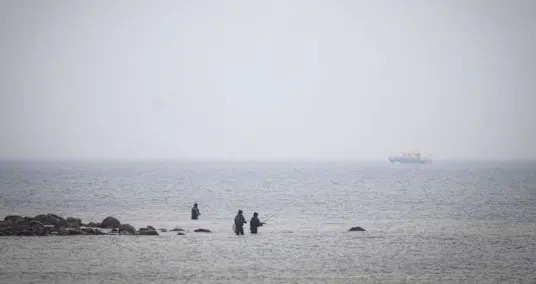
A humpback whale stranded for days off Germany's Baltic coast has gotten stuck on another sandbank, a Greenpeace spokeswoman said on Saturday.
The unlucky animal had garnered media attention for days, after it got stranded on a sandbank off Germany's Timmendorfer Strand resort, near the city of Lübeck, early on Monday.
Days of efforts to free the 12- to 15-metre whale proved unsuccessful until rescuers dug out a channel in the sand around the animal using a floating excavator on Thursday, allowing the whale to swim free the following night.
However, environmentalists and marine experts had feared that the animal could potentially get stuck again, as it was spotted heading back towards shallower water following its release.
Those fears became reality on Saturday, with the whale spotted stranded on a sandbank in the Bay of Wismar, some 40 kilometres to the east of Timmendorfer Strand, according to Greenpeace.
Large whales such as humpback whales are not native to the Baltic Sea. They may follow schools of fish in search of food and end up in the Baltic Sea.
According to experts, underwater noise could also play a role.

LATEST POSTS
- 1
 Putin says Russian forces will seize capital of Zaporizhzhya
 - 2'The Secret Lives of Mormon Wives' Season 3 premieres tomorrow. Here's what you need to know to catch up.
- 3Change Your Home into an Exercise center with These Famous Wellness Gadgets
- 4Beddings of 2024: Track down Your Ideal Fit for a Tranquil Rest
- 5I’m a dad to an autistic child. Here’s how you can make the holidays easier for all of us.




- Comet C/2025 K1 (ATLAS) breaks apart in incredible telescope photos
- Shelby County deputies charged with assault, placed on leave
- Must-See Attractions in France
- Pick Your Favored kind of sandwich
- RFK Jr.’s vaccine advisers plan biggest change yet to childhood schedule
- How a toxic self-improvement trend with a funny name took over your feed
- Israel says it killed armed Hamas 'terrorists' in Gaza
- EU-funded BioSupPack project turns brewery waste into bioplastics
- Sea level doesn’t rise at the same rate everywhere – we mapped where Antarctica’s ice melt would have the biggest impact