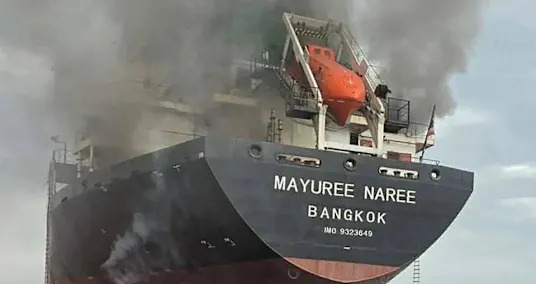

TOPSHOT - This handout photo taken on March 11, 2026 and released by the Royal Thai Navy shows smoke rising from the Thai bulk carrier 'Mayuree Naree' near the Strait of Hormuz after an attack. A Thai bulk carrier travelling in the crucial Strait of Hormuz was attacked March 11, with 20 crew members rescued so far, the Thai navy said. (Photo by Handout / ROYAL THAI NAVY / AFP via Getty Images) / ——-EDITORS NOTE —- RESTRICTED TO EDITORIAL USE - MANDATORY CREDIT "AFP PHOTO / ROYAL THAI NAVY " - NO MARKETING - NO ADVERTISING CAMPAIGNS - DISTRIBUTED AS A SERVICE TO CLIENTS -
ROYAL THAI NAVY/AFP via Getty ImagesOn February 28, 2026, companies sent unexpected emails to their logistics coordinators, instructing them to delay all outbound shipments pending review. Initially believed to be a quality issue or a labor dispute, it was later revealed to be something much more catastrophic. Halfway across the world, airstrikes had just reshaped the Middle East—and within hours, one of the world's most important waterways had effectively closed for business.
Just about 33 kilometers wide at its narrowest point, the Strait of Hormuz handles almost 11% of global maritime trade and a significant part of the world’s automotive supply chain—from the oil that powers logistics networks and the liquefied natural gas that fuels plants, to the components moving between Asia and Europe through the Gulf’s major hubs. Major shipping hubs, such as Jebel Ali Port and Hamad International Airport, located at the crossroads of Asia-Europe trade routes and facilitating the transportation of materials, parts, and finished vehicles, are also expected to be affected.
By late that Saturday evening, traffic through the Strait of Hormuz had decreased by about 70 percent, causing the largest supply disruption in the history of the global oil market, affecting nearly 20 million barrels of crude and products daily. For automotive companies, this means increased costs across the board—a rise in crude prices quickly leads to higher gasoline and diesel prices, which then affect freight rates, factory utilities, plastics, lubricants, and dealer operating expenses—directly changing how the industry behaves. The result: margin compression across the chain.
For many, the Iran conflict is a significant geopolitical event. However, for the automotive sector, it is worse. Analysts have long cautioned against depending too heavily on a single supply route and highlighted the subtle vulnerabilities of just-in-time production. And while the automotive industry struggles with a USD 60+ billion Electric car reset, the conflict will not only cause severe supply chain disruptions but also significant economic consequences.
In a matter of days, the conflict detonated into a macroeconomic shock with direct effects on the automotive industry. My forecasting team at MarketsandMarkets analyzed and identified the industry’s immediate challenges—slower growth in light vehicles, rising fuel and logistics expenses, supply disruptions for components, tighter dealer margins, and a noticeable shift in consumer preferences toward smaller, more fuel-efficient vehicles. What makes this conflict particularly significant is that it affects the industry on multiple fronts simultaneously, impacting energy, supply chains, pricing, and demand and most of these will have medium - long term impact.
LATEST POSTS
- 1
 Evidence of lost baptismal rite stage uncovered in Byzantine era cathedral near Sea of Galilee
 - 2Figure out How to Streamline Your Profits in Gold Speculation
- 3California warns of death cap mushrooms outbreak resulting in 3 deaths
- 4Am I a Summer, or is this a scam? What I learned from color analysis.
- 5Which Exhibition hall Do You Suggest? Vote




- Tens of thousands protest as far-right AfD forms new youth group
- Between 600 to 800 aid trucks entering Gaza daily since start of ceasefire, COGAT confirms
- Why is the Artemis 2 rocket launch different from all other rocket launches?
- Oil magnate’s Venezuela detainment spooks industry
- Dear Santa: I want Botox. Why cosmetic procedures are topping holiday wish lists.
- Your kid wants it now. What saying yes, no or not yet teaches kids about money and instant gratification.
- 5 Breakout Stars in Ongoing television Series
- Travels to Dream Objections in Europe
- NASA set for first crewed moon return in over half a century